There is a lot of talk right now about how AI is dramatically going to reshape the workforce – from less jobs altogether, to no graduate roles, to the death of coding and everything in between. There is a lot less written about how AI will impact the workplace itself – beyond the possibility of smaller workplaces for smaller workforces. To me, the potential for AI to reshape workplaces are much more interesting than just size.
First and foremost, workplaces should be places that respond to the process of the work being done within them (sadly not always true today). So how will AI change the process of work? Does it change the nature of our organisations or teams? Does it change how and what we use our computer for? Will it mean more meetings or less? Will we be meeting with humans or with AI agents? These are all questions to which we don’t really have solid answers yet.
Its likely that the technology changes will come faster than the human changes keep pace. For quite some time – the possibilities of what technology can deliver has been ahead of how humans want to live and work (think self driving cars or even how limited video calls were before covid). The more radical futures of AI – such as total organisational structural overhaul with everyone working as contractors assigned projects by AI systems – to me therefore seem an unlikely near term reality. In fact this contract / gig economy has been predicated for 20 odd years but has never really come to pass (this one from 2013 is worth a look). It’s not because the tech doesn’t exist to support it, but because for many individuals and organisatons alike – the security and predictability of the current corporate stable salaried models and ongoing teams has continued to be the preferred way of working.
Whilst the nature of work itself might change, it would therefore seem unlikely that the structural organsiation of the corporate world would change significantly anytime soon. This is not surprising. COVID proved that we don’t need workplaces to work but the majority of companies still have them, and in many cases, still have something very similar to what they had before COVID – it is often just used less and slightly differently. To me this suggests that the idea of what we call ‘workplace’ will continue to exist in an AI world – even if its purpose and the way it is used continues to evolve.
Different headcount growth and AI uptake scenarios are linked to differing potential outcomes for the size and quality of the workplace. Anthony Slumbers has written a great post envisioning different scenarios based upon high level impacts of AI here. Anthony talks at high level about more desks or more client space – but how does that really translate to workplace stragegy and design?
I’d like to think that AI adoption might free us from the very strong ties to the ergonomic desk and monitor, which the laptop has still not broken. One issue with the desk + monitor is that this is the most single use / inflexible unit of space our workplaces contain today. 1 person equals 1 desk + monitor (or more monitors). Whilst occupancy fluctuates day to day, the desks sit empty. But we have to have enough just in case. Heaven forbid someone comes in and can’t find a desk with a monitor – they might never return. These desks with monitors then end up taking up more space than they deserve based upon their use patterns. According to XY Sense data “Up to 31% of desks are never used on a given day, while 21% are used for less than one hour [a day]” This fits with what I see in our own observation studies.
It’s hard to use a desk with a monitor for much else than single use work (and often not focus work either). Real collaboration between more than 2 people is blocked by monitors, and often even paired collaboration is distracting to neighbours. However, small rooms or desks without monitors get used even less often that the desks with monitors.
What if AI means we no longer need a monitor? What if it means we spend less time looking at screens? Alternatively what if it means we need more and even bigger screens?
Technologies for projecting onto surface have existing for a long time. The limitations have been about what they can project onto and how we can interact with them. What if you could project onto any surface and it could become a touch based interface? Laser based projection keyboards have been around for awhile and are already available for under $100 on Amazon. I think the reason they don’t have a high takeup is for many the tactile nature of keyboards helps to touch type, otherwise you might as well just use your phone keyboard. There is even a paint that promises to be a surface suited to an interactive projection screen! The solution to more larger displays might not be the size of a desk but the size of a room.
With AI we might not even need to ever touch these projections. Voice assistants are taking over. This adds another dimension to how we consider the future workplace. If we are all talking to our AI agents all day, how will the open plan office work? Will we all be working in the atmosphere of a call centre? This leads to the question – will AI replace focus work as we know it today? Or will it replace what we term ‘interruptible work’, the tasks like some email and scheduling meetings where it doesn’t matter if you colleagues are chatting around you. Likely it will be replacing some of both types of work, with supervising our AI agents becoming a more significant task.
If we spend less time focusing and less time on interruptible work – will we therefore spend more time collaborating? With humans or with AI systems? Or both? Already today, both seems to be emerging as the answer. AI supports us in our meetings and is likely to become a more active collaborator in future. But will this mean more meeting rooms?
Already we find in many organisations that 90% of meetings are for 3 people or less (published from XY Sense is 94% are 6 or less people), with many knoweledge workers already in back to back meetings all day. Perhaps we won’t need more rooms (although most workplaces today still don’t have enough). We will need rooms designed to suit these new ‘hybrid’ human AI collaborations where voice activated systems and large displays allow human participants to interact with the AI – either in person or virtually. Perhaps our virtual colleagues will arrive as holograms (again already possible, this Microsoft demo is six years old). In all likelihood this means flexible ‘loose tech’ spaces where technology and furniture can change to suit different types of interactions.
We probably won’t really want to go for lunch or a drink with our holographic friends though. So perhaps the most important things will remain spaces that humans want to inhabit – natural light, plants, variety and control of the environment is what people tend to actually want -and use.
A number of conversations I’ve had on this topic have lead me to MIT,s famous building 20 (which I have mentioned here before). A space that is flexible and hackable, with private spaces to focus or meet, and opportunities for incidental connection. What stands out most to me always in the stories of this building, is not just the physical, but the sense of community and the purpose. All of these are things which the places we work today and in the future should aspire to – regardless of if they are offices, co-working spaces or cafes.
Meantime, what if all those open plan desks were no longer required? What would you repurpose the space to? I don’t think just filling it with a variety of ‘collaborative’ lounges will be the answer. Don’t despair of the open plan office just yet though – co-pilot tells me we might need ever larger desks with more and more monitors…
Ceilidh Higgins
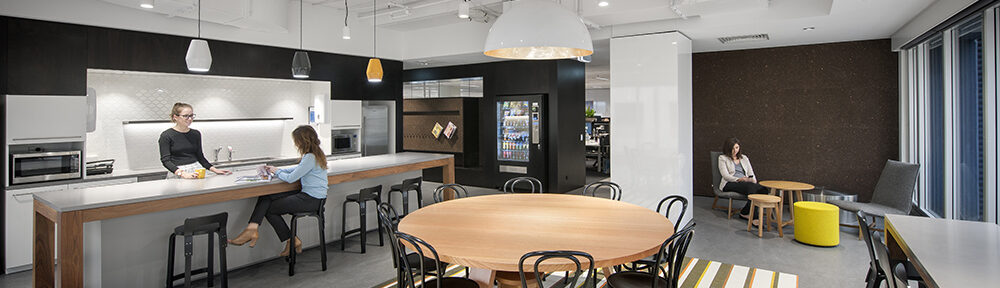
Image via ChatGPT


