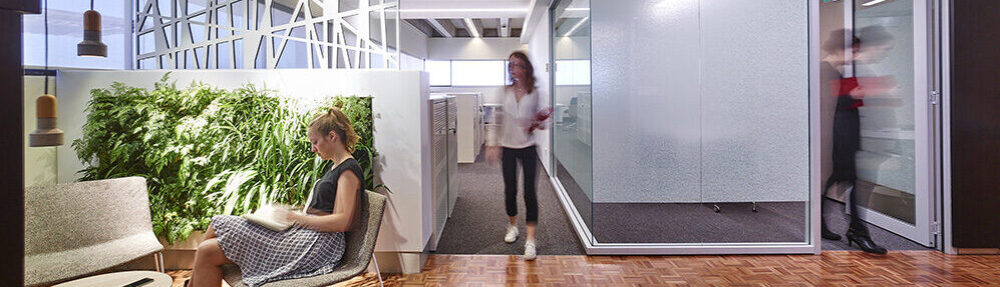
 Frequently the question is raised “Does office design increase workplace productivity?” or some other slight variation of this such as increases to staff motivation, retention, collaboration or other desirable attributes to enhance business performance. I came across one such discussion just this week on Linkedin with some great discussion points. With the current trend towards activity based workplaces and the groovy workplaces of Facebook and Google frequently featuring in the media, many organisations use the time for moving into a new office as an opportunity to question how their new office should differ from the previous one. However, the problem that I have frequently seen is that frequently the business leadership are not highly involved in the decisions of design.
On a regular basis, our clients are often represented by the facility managers, project managers or people with a financial background. They will say to us I want x number of desks at x dollars/square metre by x date. And often and this is how big/shaped the desks are to be. Their brief (or performance metric) is to provide an office with a certain number of desks at a certain cost by a certain date. And if the desks are the same as what the organisation has now, they believe no-one will complain too much. However this is not the way to create great work places. “…a clear understanding of the organizations cultural inclinations (motivations) and therefore their desired behaviors, is the only way to create a workplace design for the future that is truly effective and supports a particular organization.” (quoted from a comment by Jack Webber on Office Insight: The Business of Workplace Design and Management)
How can we as designers help to educate our clients about the human value of office space when the people who care about the bigger picture – usually the leadership team or the human resources staff are absent from the design meetings? These are the people that can provide the cultural information about the organisation to the design team and who should appreciate the project of the new workplace as it impacts upon the overall business – not just as a one of project to be ‘delivered on time and on budget’.
In larger organisations, all too often the business decision makers are only brought into the room when a significant amount of design time has been spent and many basic decisions have been made. They are there to be “presented to” so they can “sign off”. Sometimes the interior design team never have a chance to even present to those with the authority to make the final decisions.
Frequently this means that key players in the business are not party to much information, discussion and preliminary design materials. They miss the opportunity to input into strategies for cultural and business change through design – perhaps because they don’t understand that a new workplace will result in cultural change or they don’t understand the need to align and prepare the business and manage the staff in advance of the move or that design can be used to reinforce desired cultural changes.
Human resources staff are often left out of the equation altogether unless brought in to manage staff consultation (a whole topic for another day). One of the best projects I have worked on had the HR manager as the key representative. It made a huge difference as to what was seen as a priority and what was presented to the higher management. The needs of staff were taken into account in an intelligent way at a high level, not simply giving in to or providing every small thing that was asked for or denying everything, but decisions made with a real understanding the roles the staff performed and the functional requirements.
Whilst facilities managers are quite frequently very knowledgeable about their organisation and its staff and may have an interest in design they are not usually the drivers of change within organisations. One FM once said to me something along the line of “but why would I want to get involved in trying to change the culture via the new office design, it’s not my job and my job is hard enough trying to keep everyone happy with the new office as it is – I have no desire to change too much”. And I guess that’s fair enough, it’s not their role, background or training. Cultural change and change management is a high level leadership issue. However perhaps as the design of the workplace is changing, facilities management will also change. The Sodexo Workplace Trends 2013 report states that
“To be effective, FM leaders must change their behaviors, and indeed their very identity. FM is not about managing facilities per se; rather, it is about enabling the workforce to be productive and engaged, and to produce value for the organization.”
Part of the point though is that it is not just involving the business leadership or the HR team, it is about these leaders valuing their staff and valuing the part the design of their workplace plays in business processes and staff satisfaction. If the business leaders are involved in the design process but do no more than focus on the size of their own office then they are not effective contributers either. In the end a great office design that enhances an organisations business and improves staff motivation and morale comes out of great leadership. Most people wouldn’t stay working in a google type office just because it had a slide and a ping pong table if that was the only positive thing their company could offer them.
How do we as interior designers get our clients to appreciate the role of business leadership in workplace design? Or do they appreciate it already but just not have the time? Do we need to change our approach to business leaders? Does the role of facilities management need to change? Can HR play a greater part in workplace design? And do you think all of this really lead to better workplaces?


